
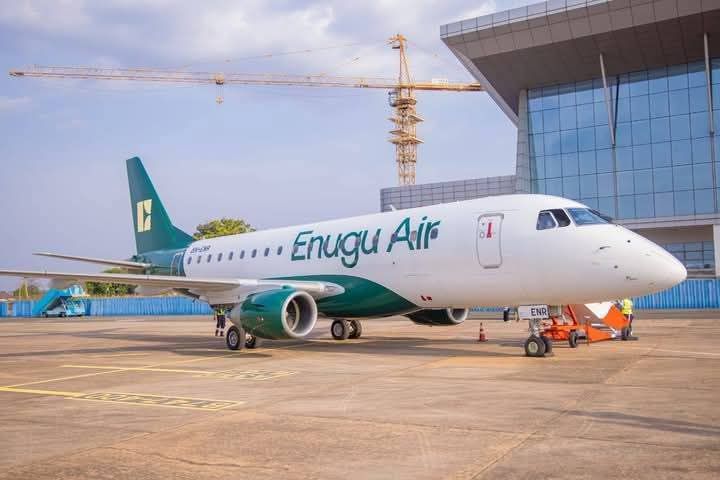
ENUGU AIR: THE BUSINESS BEHIND THE AIRLINE
ENUGU AIR: CAN A STATE-OWNED AIRLINE BECOME THE ECONOMIC ENGINE OF A REGION?
A Business Review of Enugu State’s Ambitious Aviation Bet
Executive Summary
When Enugu Air took to the skies on 7 July 2025, it entered one of Nigeria’s most difficult businesses: commercial aviation.
Airlines operate in an unforgiving environment. They require expensive aircraft, highly trained personnel, strict regulatory compliance, reliable infrastructure, foreign-exchange exposure, maintenance capability and consistently strong passenger demand. At the same time, ticket prices are highly visible to consumers, creating constant pressure to remain competitive.
Yet Enugu Air was not created merely to become another Nigerian domestic airline.
The Enugu State Government has positioned it as part of a broader economic-development strategy designed to improve connectivity, stimulate tourism and investment, support commerce and strengthen Enugu’s position as a regional hub.
That ambition has developed rapidly.
The airline launched with three Embraer regional aircraft and operated initially through a partnership with XEJet while pursuing its own Air Operator Certificate. In March 2026, the Nigerian Civil Aviation Authority issued Enugu Air its own AOC after the airline completed the certification process. The state subsequently reported a six-aircraft fleet and announced plans to expand to 20 aircraft.
By September 2026, Enugu Air had moved beyond domestic operations, launching its first international service between Enugu and Douala, Cameroon. The airline described the route as the beginning of a broader regional African network.
This makes Enugu Air an unusually interesting business case.
The question is no longer simply:
Can Enugu Air fly?
It is:
Can Enugu Air become a financially sustainable aviation platform that creates economic value far beyond its own balance sheet?
1. Enugu Air at a Glance
Enugu Air is wholly owned by the Enugu State Government and is headquartered at Akanu Ibiam International Airport in Enugu.
The airline was launched as part of Governor Peter Mbah’s broader transport and economic-transformation agenda.
At launch, the state announced an initial fleet of three Embraer E170/E190-series aircraft, with Enugu positioned at the centre of a domestic network linking the city initially with Lagos and Abuja and subsequently other Nigerian cities.
The airline’s initial operating structure is important.
Rather than waiting until every stage of its own certification was complete, Enugu Air entered the market through an arrangement with XEJet, a Nigerian aviation company that operated the aircraft while the airline completed the regulatory process for its own AOC. The NCAA subsequently confirmed the airline’s independent certification in March 2026.
This allowed the project to move from government plan to commercial operation relatively quickly.
That speed, however, should not be confused with the completion of the business-building process.
Starting an airline is one achievement.
Building a reliable, profitable and resilient airline is another.
2. The Real Strategy: Enugu Air as Economic Infrastructure
The most interesting aspect of Enugu Air is that the state government does not appear to view the airline as an isolated commercial venture.
It is part of a larger ecosystem.
The government’s stated strategy combines:
Airline + Airport + Roads + Tourism + Logistics + Investment + Trade
The logic is straightforward.
Better air connectivity can:
- Reduce travel time for businesses
- Attract investors
- Improve access to markets
- Support tourism
- Facilitate business travel
- Improve regional connectivity
- Strengthen the attractiveness of Enugu as a place to live and work
The state has explicitly linked Enugu Air and the Akanu Ibiam International Airport concession to its ambition to grow the Enugu economy from approximately $4.4 billion to $30 billion by 2031.
This is an important distinction.
The airline does not necessarily have to create all the economic value itself.
Its wider value may come from enabling other businesses to create value.
For example:
A consultant can travel more easily to Enugu.
A manufacturer can meet customers more efficiently.
A tourist can reach Enugu directly.
A trader can connect to another market.
An investor can make a same-day business trip.
A conference organiser can attract participants from outside the South-East.
In economic-development terms, connectivity is an input.
3. The Akanu Ibiam Airport Connection
The airport is arguably as important to Enugu Air’s future as the aircraft themselves.
In June 2026, the Federal Government formally handed over Akanu Ibiam International Airport to Aero Alliance Limited under a public-private partnership.
Under the arrangement, Aero Alliance is expected to finance, rehabilitate, expand, operate and manage the airport. The objective is to improve safety, efficiency and passenger experience while developing the facility into a regional aviation and logistics hub.
This creates an unusual strategic alignment.
Enugu Air needs a strong home airport.
The airport concessionaire needs sufficient passenger and cargo activity.
The state wants greater economic activity.
Businesses need reliable connectivity.
If these interests are properly coordinated, the relationship could become mutually reinforcing.
The Potential Flywheel
Better airport → better passenger experience → more airlines and routes → more passengers → more business activity → stronger regional economy → greater demand for aviation.
Enugu Air could become one of the catalysts inside that flywheel.
But there is also a risk.
If airport development and airline expansion occur without sufficient passenger demand, the infrastructure may become underutilised.
The commercial challenge is therefore to create demand rather than simply create capacity.
4. From Three Aircraft to Six—and Potentially 20
Fleet expansion has been one of the most ambitious aspects of the Enugu Air strategy.
The airline launched with three aircraft.
By March 2026, the Enugu State Government stated that the airline had a six-aircraft fleet. It also announced an ambition to expand the fleet to 20 aircraft by the end of 2026.
This is an extraordinary growth target for an airline that only commenced operations in 2025.
The state had also allocated ₦41.13 billion in its 2025 budget for expanding Enugu Air through additional aircraft acquisition.
The strategic logic is understandable.
More aircraft can allow:
- More routes
- Higher frequency
- Better schedule flexibility
- More direct connections
- Increased passenger capacity
- Improved aircraft utilisation
- Stronger network effects
But aviation economics impose a fundamental discipline:
An aircraft only creates value when it flies productively.
An aircraft sitting on the ground is still generating costs through financing or capital opportunity cost, maintenance, insurance, crew requirements and other overheads.
The critical metrics therefore become:
- Load factor
- Aircraft utilisation
- Revenue per available seat kilometre
- Cost per available seat kilometre
- Route profitability
- On-time performance
- Maintenance turnaround
- Fleet availability
This is why fleet growth should ideally follow demonstrated route demand rather than precede it.
5. The Economics of a Nigerian Airline
Enugu Air operates in the same difficult economic environment as other Nigerian airlines.
The industry faces a structural mismatch.
Most airline revenue is generated in naira, while several major costs are linked directly or indirectly to foreign currencies.
These include:
- Aircraft acquisition
- Aircraft leasing
- Maintenance
- Spare parts
- Pilot training
- Simulator training
- Insurance
- Aviation technology
- Some airport-related costs
The problem becomes more severe when the naira weakens.
An airline can sell more tickets but still experience margin pressure if its dollar-linked costs rise faster than its naira revenue.
This is one reason why airline management cannot focus only on passenger numbers.
Revenue growth is not the same as economic sustainability.
The business needs strong cost discipline and route-level economics.
6. Enugu Air’s Early Revenue Signal
One of the most interesting developments came from Enugu State’s Q1 2026 budget performance reporting.
Premium Times reported that Enugu Air was the state’s largest internally generated revenue contributor during the first quarter, with ₦11.59 billion in reported earnings.
This is significant because it suggests that the airline was already generating substantial financial activity relatively early in its life.
However, caution is necessary.
The figure comes from the state’s revenue reporting framework. It should not automatically be interpreted as Enugu Air’s audited net profit or proof that the airline is commercially profitable.
For a proper corporate assessment, investors and policymakers would need to see:
- Passenger revenue
- Cargo revenue
- Ancillary revenue
- Operating expenses
- Fuel costs
- Maintenance expenses
- Staff costs
- Aircraft acquisition/financing costs
- Depreciation
- Cash flow
- Route-level profitability
This distinction is critical.
A state-owned airline can generate significant revenue while still requiring substantial capital support.
The real question is whether the revenue eventually produces sustainable free cash flow.
7. Building the Domestic Network
Enugu Air’s domestic strategy has evolved considerably.
The airline initially focused on the key Lagos–Abuja–Enugu triangle before extending its network.
By September 2026, the airline said it had built domestic connections linking Enugu with:
- Lagos
- Abuja
- Port Harcourt
- Kano
- Owerri
- Asaba
- Benin City
- Warri
The airline’s CEO described the domestic network as the foundation for its next stage of international expansion.
This is strategically sensible.
An airline needs a network rather than isolated routes.
A passenger travelling from one city can potentially connect through Enugu to another destination, increasing aircraft utilisation and strengthening the value of the hub.
The challenge is frequency.
Passengers generally prefer airlines that offer:
- Convenient departure times
- Multiple weekly frequencies
- Reliable schedules
- Easy connections
- Competitive fares
A large network with infrequent flights may be less valuable than a smaller network with excellent frequency and reliability.
8. Enugu to Douala: The Bigger Strategic Move
On 23 September 2026, Enugu Air launched its first international service between Enugu and Douala, Cameroon.
This route is important for reasons beyond aviation.
Douala is Cameroon’s principal commercial city and an important business and logistics centre.
A direct Enugu–Douala connection potentially serves:
- Traders
- Manufacturers
- Business travellers
- Investors
- Tourists
- Families
- Regional organisations
It also positions Enugu closer to the Central African market.
The airline’s CEO described the move as a step toward building a broader regional African network.
This could eventually support a strategy in which Enugu functions as a connecting point between southeastern Nigeria and selected African markets.
But again, route economics matter.
International routes require adequate:
- Passenger demand
- Frequency
- Immigration/customs coordination
- Ground handling
- Marketing
- Schedule reliability
- Bilateral aviation rights
- Aircraft availability
Launching the route is therefore only the beginning.
The real test will be whether Enugu–Douala develops sustainable traffic.
9. The Regional Hub Ambition
The state government’s vision is considerably bigger than Enugu–Lagos or Enugu–Abuja.
It wants Enugu to become a regional aviation hub.
This is strategically attractive because the South-East has a large population, substantial commercial activity, a strong diaspora and significant movement of traders and professionals.
But a hub is not created simply by declaring one.
A successful aviation hub requires:
Connectivity + frequency + reliable infrastructure + competitive fares + transfer convenience + strong passenger demand.
It also requires network density.
If passengers can reach more destinations directly from Enugu, the airport becomes more valuable.
If Enugu Air can connect those passengers efficiently, the airline becomes more valuable.
This creates a classic network effect.
10. The South-East Market Opportunity
The commercial opportunity behind Enugu Air is significant.
The South-East has:
- Large commercial centres
- Strong SME activity
- Manufacturing clusters
- Major markets
- Universities
- Religious tourism
- Medical travel
- A large domestic and international diaspora
- Significant inter-state business movement
Yet regional air connectivity has historically been weaker than the economic importance of the region might suggest.
Enugu Air can potentially reduce this connectivity gap.
For example, direct flights between South-Eastern cities can eliminate the need for passengers to travel through Lagos or Abuja.
That can reduce:
- Travel time
- Connecting-flight risk
- Cost of missed connections
- Business travel friction
The opportunity is therefore not merely to transport passengers.
It is to reduce the transaction cost of doing business across the region.
11. Safety: The Non-Negotiable Competitive Advantage
Aviation is different from most businesses because safety cannot be treated as just another operational KPI.
In July 2026, an Enugu Air Embraer E170 operating from Lagos to Benin overran the end of Runway 05 during landing.
There were 63 passengers and five crew members on board. All occupants were accounted for and no injuries were reported. The Nigerian Safety Investigation Bureau opened an investigation and secured the aircraft while gathering operational and technical evidence.
The incident should not be sensationalised.
A runway excursion is not synonymous with a crash, and the absence of injuries is important.
But from a business perspective, incidents create a different responsibility.
As an airline grows, its safety culture must scale even faster than its fleet.
This means investing continuously in:
- Pilot training
- Maintenance
- Safety management systems
- Incident reporting
- Operational risk assessment
- Ground operations
- Crew resource management
- Emergency response
- Regulatory compliance
The airline received its own AOC only in March 2026, so maintaining a strong safety record will be central to building public confidence as the network expands.
12. Regulatory Credibility Matters
The NCAA’s issuance of Enugu Air’s AOC in March 2026 was an important institutional milestone.
The regulator said the airline completed the certification process in five months and three weeks and had undergone operational demonstrations, documentation reviews and multiple evaluations.
The significance extends beyond paperwork.
An airline owned by a government has an additional governance challenge.
The public needs confidence that:
- Safety decisions are independent
- Commercial decisions are professionally made
- Political considerations do not override operational requirements
- Procurement is transparent
- Management is accountable
- Regulatory standards apply equally
State ownership does not inherently make an airline inefficient.
But it makes governance particularly important.
13. State Ownership: Advantage or Risk?
Enugu Air’s ownership model gives it several potential advantages.
Access to Government Support
The airline can potentially benefit from state-level strategic backing and infrastructure coordination.
Long-Term Strategic Vision
Government may be willing to pursue infrastructure and connectivity objectives that private investors might consider too long-term.
Regional Development Mandate
The airline can serve routes that may have wider economic-development value.
But the disadvantages are equally important.
Political Interference
Commercial decisions can become politicised.
Soft-Budget Risk
If losses are repeatedly covered by public funds, management may have weaker incentives for efficiency.
Procurement Risk
Large aircraft purchases require strong transparency and value-for-money controls.
Accountability
Citizens ultimately bear the opportunity cost when public capital is invested in commercial ventures.
This leads to a fundamental governance principle:
If a government owns a commercial airline, the airline should still be managed according to commercial disciplines.
14. Enugu Air and the $30 Billion Enugu Economy
The airline makes more sense when viewed within the state’s wider economic strategy.
The Enugu Government has set an ambition of growing the state economy from approximately $4.4 billion to $30 billion by 2031. Aviation is one of several components of that plan.
The strategy also includes:
- Airport development
- Tourism
- Agriculture
- Industrialisation
- Roads
- Transport infrastructure
- Investment promotion
- Logistics
The important question is whether these initiatives reinforce one another.
Consider the potential chain:
Better roads → easier airport access
Better airport → more flights
More flights → more visitors and investors
More visitors → stronger hospitality and tourism
More connectivity → easier trade
More trade → stronger businesses
Stronger businesses → higher economic activity
This is the economic-development argument for Enugu Air.
The airline is valuable if it helps activate this ecosystem.
15. Tourism as a Potential Growth Partner
Enugu has significant tourism assets, including hills, waterfalls, caves, forests and cultural attractions.
The state government is investing in tourism infrastructure and has linked aviation expansion to its wider tourism-development agenda.
Enugu Air can potentially become part of the tourism distribution system.
But there is an important distinction.
An airline cannot create a tourism industry by itself.
It needs:
- Attractive destinations
- Quality hotels
- Tour operators
- Safe transportation
- Digital booking infrastructure
- Events
- International marketing
- Good visitor experiences
This creates another opportunity for private-sector participation.
The state can provide infrastructure and enabling conditions while private businesses build tourism products around them.
16. Cargo Could Be the Next Frontier
Passenger traffic is only one side of the aviation opportunity.
The state’s plans around Akanu Ibiam International Airport also include cargo development.
In June 2026, the state government said Enugu–Guangzhou cargo flights were expected to commence within months as part of the airport’s broader transformation.
Cargo could be particularly relevant to the South-East because of its:
- Manufacturing base
- Agricultural production
- Trading networks
- Import/export activity
- Pharmaceutical and medical needs
- SME ecosystem
An aviation strategy that eventually combines:
Passengers + Cargo + Logistics + Tourism
could have substantially greater economic impact than a passenger-only airline.
17. The Biggest Business Challenge: Scale vs. Sustainability
Enugu Air’s ambitions are impressive.
But aviation rewards disciplined growth.
Moving from three aircraft to six is one thing.
Moving toward 20 requires a much larger organisational platform.
The airline will need:
- More pilots
- More cabin crew
- Maintenance capacity
- Engineering support
- Ground handling
- Customer service
- Revenue management
- Network planning
- Aviation technology
- Finance
- Risk management
- Safety oversight
- Commercial partnerships
The organisation must therefore grow at the same pace as the fleet.
Otherwise, rapid expansion can create operational fragility.
The key question is not:
How many aircraft can Enugu Air acquire?
It is:
How many aircraft can Enugu Air operate efficiently, safely and profitably?
18. Competitive Landscape
Enugu Air does not operate in an empty market.
Nigeria has established carriers including:
- Air Peace
- United Nigeria Airlines
- Ibom Air
- Arik Air
- Overland Airways
- Green Africa Airways
- ValueJet
Several already serve major Nigerian routes.
The challenge for Enugu Air is therefore differentiation.
Its competitive proposition could be built around:
Network
Direct connections to and from Enugu.
Reliability
Consistent schedules and fewer disruptions.
Regional Identity
A strong connection with the South-East market.
Customer Experience
Professional service and digital convenience.
International Connectivity
Direct access to selected African destinations.
Hub Strategy
Using Enugu as a connecting point rather than merely an origin/destination.
Price alone is unlikely to be a sustainable differentiator.
19. Technology and Customer Experience
A modern airline must increasingly operate as a digital business.
The customer journey includes:
Search → Booking → Payment → Check-in → Boarding → Flight → Baggage → Feedback
Every stage provides opportunities for technology.
Enugu Air’s digital platform and booking infrastructure can potentially support:
- Online booking
- Digital check-in
- Mobile notifications
- Loyalty programmes
- Personalised offers
- Customer feedback
- Revenue management
- Route-demand analysis
Data will become particularly important as the network expands.
The airline needs to know:
- Which routes have the strongest demand?
- Which departure times sell best?
- Which customers are frequent travellers?
- Where are passengers connecting from?
- What is the optimal aircraft for each route?
- Which routes lose money?
Good data can prevent expensive strategic mistakes.
20. Key Risks Facing Enugu Air
1. Foreign-Exchange Risk
Many aviation expenses are linked to foreign currency while ticket revenue is predominantly naira-denominated.
2. Fleet Expansion Risk
Rapid aircraft acquisition can create substantial capital and operating commitments.
3. Low Load Factors
A large network without sufficient passenger demand can destroy profitability.
4. Maintenance Risk
Aircraft availability directly affects revenue and customer confidence.
5. Fuel Costs
Fuel is one of the largest airline operating expenses and remains sensitive to global energy prices and domestic supply conditions.
6. Regulatory Risk
Continued compliance with NCAA requirements is essential.
7. Safety Risk
Any major incident could severely damage a young airline’s reputation.
8. Political Risk
Government ownership creates potential exposure to political rather than purely commercial decision-making.
9. Competition
Established Nigerian carriers already possess route knowledge, customer bases and operating experience.
10. Infrastructure Dependence
The airline’s hub ambitions depend heavily on the performance of Akanu Ibiam International Airport and associated infrastructure.
11. Demand Risk
The success of international routes depends on whether sufficient passenger and cargo demand develops.
21. What Should Management Measure?
For Enugu Air to mature into a commercially accountable enterprise, its performance should be evaluated using transparent aviation metrics.
These should include:
| KPI | Why It Matters |
|---|---|
| Passenger load factor | Measures aircraft utilisation |
| Revenue per passenger | Shows monetisation |
| Cost per passenger | Indicates efficiency |
| Aircraft utilisation | Shows how productively aircraft are used |
| On-time performance | Measures reliability |
| Cancellation rate | Measures operational resilience |
| Route profitability | Identifies commercially viable routes |
| Maintenance downtime | Measures fleet availability |
| Customer satisfaction | Measures service quality |
| Ancillary revenue | Measures monetisation beyond fares |
| Cash flow | Measures financial sustainability |
| Safety indicators | Measures operational risk |
This is particularly important because public ownership makes transparency even more valuable.
22. Strategic Lessons for Business Leaders
Lesson 1: Infrastructure Can Be a Business Strategy
Enugu Air demonstrates how transportation infrastructure can be used to support broader economic development.
Lesson 2: Scale Without Utilisation Is Expensive
More aircraft are valuable only when they generate sufficient productive activity.
Lesson 3: Government-Owned Businesses Still Need Commercial Discipline
Public ownership should not mean abandoning financial accountability.
Lesson 4: Connectivity Can Create Indirect Economic Value
An airline’s contribution should be measured not only through its own profit but also through the business activity it enables.
Lesson 5: Partnerships Can Accelerate Execution
The early partnership with XEJet allowed Enugu Air to enter the market while completing its own regulatory certification.
Lesson 6: Safety Must Scale Faster Than Growth
Rapid expansion makes operational discipline more important, not less.
Lesson 7: Regional Economic Development Requires an Ecosystem
Airlines, airports, hotels, logistics firms, manufacturers, tourism businesses and government must reinforce one another.
Lesson 8: The Real Test Is Sustainability
The most important milestone will not be the next aircraft acquisition or route launch.
It will be the point at which Enugu Air can demonstrate that its network is safe, reliable, commercially disciplined and financially sustainable.
Conclusion
Enugu Air is one of the most ambitious state-owned commercial ventures in Nigeria’s recent economic-development landscape.
In just over a year, it has moved from a three-aircraft domestic launch to its own AOC, a larger fleet, an expanding domestic network and an international route linking Enugu directly with Douala.
But the real significance of Enugu Air goes beyond aviation.
It represents an attempt to use connectivity as an economic-development tool.
If successful, the airline could help:
- Connect the South-East to major Nigerian markets
- Support tourism
- Facilitate investment
- Improve business mobility
- Strengthen trade
- Support cargo logistics
- Position Enugu as a regional hub
The opportunity is substantial.
So are the risks.
The airline’s long-term success will depend on whether its ambitious growth can be matched with strong governance, safety discipline, route economics, customer trust, operational reliability and financial accountability.
The most important question for Enugu Air is therefore not whether it can become a large airline.
It is whether it can become a sustainable airline that creates economic value beyond its own operations.
That is the real test of the Enugu Air experiment.
In aviation, taking off is an achievement. Staying commercially and operationally airborne is the business.
This report is a business research review and does not constitute investment advice.










Leave a Reply