
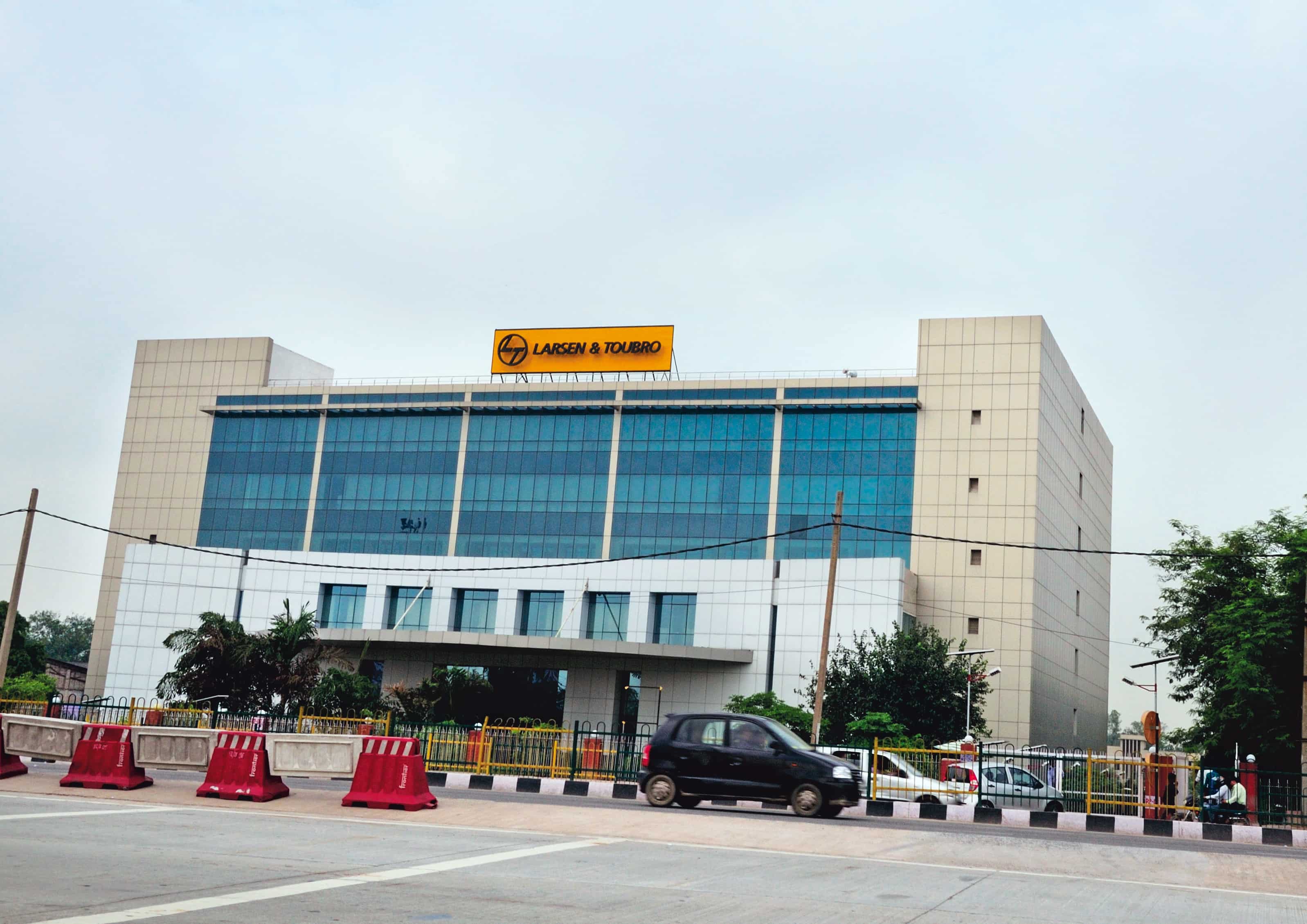
L&T’S STRATEGIC TRANSFORMATION: FROM EPC TO THE FUTURE
L&T: From Building Infrastructure to Building the Future
How Larsen & Toubro Is Transforming an Engineering Legacy into a Global Technology and Infrastructure Powerhouse
Executive Summary
Larsen & Toubro (L&T) has spent almost nine decades building a reputation around engineering, construction and project execution.
Today, however, describing L&T simply as an engineering and construction company misses the scale of its transformation.
The Indian multinational now operates across Engineering, Procurement and Construction (EPC), hi-tech manufacturing, technology services, financial services, digital infrastructure, defence, semiconductors and energy transition. It operates in more than 50 countries and has manufacturing facilities in eight countries outside India.
The numbers illustrate the scale of the business.
For FY2025–26, L&T Group recorded:
- ₹4.36 lakh crore in order inflows, a company record and a 22% year-on-year increase.
- ₹7.40 lakh crore in order book, up 28%.
- ₹2.86 lakh crore in revenue, up 12%.
- ₹17,238 crore in recurring profit attributable to owners, up 18%.
- 52% of the order book from international markets.
But perhaps the most interesting part of L&T’s story is not its financial size.
It is where the company is directing its capabilities.
L&T is investing in AI-ready data centres, semiconductor products, green hydrogen and ammonia, advanced manufacturing, defence technology and digital services.
This makes L&T a useful case study in a broader strategic question:
How does an established industrial company reinvent itself without abandoning the engineering capabilities that made it successful in the first place?
1. L&T at a Glance
Larsen & Toubro is an Indian multinational group engaged in EPC projects, hi-tech manufacturing and services.
Its operations span infrastructure, energy, defence, manufacturing, technology, financial services, real estate and digital infrastructure.
The company’s stated capabilities extend across the entire “design to delivery” spectrum, allowing it to participate in projects from engineering and procurement through construction, manufacturing, commissioning and lifecycle services.
This integrated capability is one of the company’s most important competitive characteristics.
Rather than competing only for individual construction contracts, L&T can participate across multiple stages of complex projects.
That creates opportunities for:
- Cross-selling between business units
- Shared engineering capabilities
- Procurement economies
- Technology transfer
- Repeat customer relationships
- International expansion
- Long-term lifecycle contracts
The model is particularly valuable for large infrastructure and industrial projects where technical complexity and execution credibility matter.
2. The Order Book: L&T’s Strategic Moat
One of the strongest indicators of L&T’s current position is its order book.
During FY2025–26, the group secured record order inflows of ₹4.36 lakh crore, representing growth of 22.1% over the previous year.
Its order book reached ₹7.40 lakh crore, an increase of 28%.
More importantly, international orders accounted for 52% of the backlog.
This provides significant revenue visibility because today’s orders become tomorrow’s project execution and revenue.
The composition is also revealing.
FY2025–26 order inflows included approximately:
| Business | Order Inflow |
|---|---|
| Infrastructure Projects | ₹1.99 lakh crore |
| Energy Projects | ₹1.37 lakh crore |
| IT & Technology Services | ₹53,497 crore |
| Financial Services | ₹17,283 crore |
| Hi-Tech Manufacturing | ₹8,366 crore |
| Development Projects | ₹5,103 crore |
Infrastructure and energy therefore remain the backbone of the business, while technology and manufacturing provide important diversification.
Why This Matters
For an EPC company, an order book is more than a sales pipeline.
It represents committed future work—but converting that backlog into attractive profits depends on execution.
L&T therefore faces a strategic challenge:
How do you turn a record backlog into equally strong cash generation and returns without allowing complexity to erode margins?
3. Internationalisation Has Become Structural
L&T’s international expansion is no longer simply an additional growth strategy.
It is becoming a fundamental component of the business.
International orders exceeded domestic orders for the third consecutive year in FY2025–26. The GCC countries were particularly important, with major wins across infrastructure and energy.
This geographic diversification provides several benefits.
Diversification of Demand
A slowdown in one market does not necessarily translate into a group-wide slowdown.
Access to Large Capital Projects
The GCC continues to invest heavily in infrastructure, energy, industrial facilities and urban development.
Export of Indian Engineering Capability
L&T can use its Indian engineering and manufacturing base to compete internationally.
Stronger Global Relationships
Large international projects can lead to repeat contracts and long-term customer relationships.
However, internationalisation introduces new risks.
L&T is exposed to:
- Geopolitical instability
- Currency fluctuations
- Local regulations
- Cross-border supply chains
- Political risk
- Labour and procurement requirements
- Regional conflicts
The company itself noted that developments in West Asia created near-term uncertainty and that management was monitoring employee safety, business continuity and asset protection.
International diversification can therefore reduce dependence on a single market while simultaneously increasing geopolitical complexity.
4. L&T’s Most Interesting Transformation: From EPC to Technology
Perhaps the most important strategic development is L&T’s movement into technology-intensive businesses.
The company is increasingly using engineering expertise as a bridge into sectors that did not traditionally sit within the construction industry.
Three areas stand out.
A. Semiconductors
L&T Semiconductor Technologies is developing semiconductor products for applications including automotive, industrial, energy, data centres and telecommunications.
In September 2026, LTSCT unveiled 40 products at SEMICON India, including its first silicon-carbide product platform and a fully designed-in-India BLDC motor controller.
This is strategically important because semiconductors sit at the centre of modern industrial competitiveness.
They power:
- AI systems
- Electric vehicles
- Industrial automation
- Energy systems
- Telecommunications
- Defence technology
- Consumer electronics
L&T is therefore attempting to move further upstream—from constructing industrial systems to developing some of the technologies embedded within them.
B. AI-Ready Data Centres
L&T Vyoma represents another major strategic shift.
In January 2026, L&T began construction of a 40 MW green, AI-ready data centre in Navi Mumbai as the first stage of a planned 100 MW campus.
The company says its broader roadmap targets more than 200 MW of data-centre capacity across India.
The facilities are being designed for high-density AI workloads, including direct-to-chip liquid cooling and renewable-energy integration.
This is a logical extension of L&T’s traditional capabilities.
Data centres require:
- Construction expertise
- Electrical infrastructure
- Cooling systems
- Power management
- Physical security
- Digital connectivity
- Energy management
- Advanced engineering
L&T can therefore apply decades of physical infrastructure expertise to a rapidly expanding digital infrastructure market.
5. Energy Transition: Turning Engineering Expertise into a Green Business
L&T is also positioning itself in the energy transition.
Its green-energy portfolio includes:
- Green hydrogen
- Green ammonia
- Green methanol
- Electrolysers
- Fuel cells
- Energy storage
- Carbon-reduction technologies
- Renewable energy infrastructure
L&T Electrolysers manufactures pressurised alkaline electrolysers, while L&T Energy GreenTech provides engineering and development capabilities for hydrogen and its derivatives.
The company has also secured international and domestic green-energy opportunities.
In 2026, L&T Energy GreenTech signed a long-term agreement with Japan’s ITOCHU Corporation to supply 300,000 tonnes of green ammonia annually.
This illustrates an important strategic shift.
L&T is not simply helping customers build conventional energy infrastructure.
It is attempting to become part of the infrastructure of the low-carbon economy.
6. Can Sustainability Become a Growth Business?
This is one of the most interesting aspects of L&T’s strategy.
Many companies treat sustainability primarily as compliance.
L&T increasingly treats it as a market opportunity.
According to its FY2025–26 sustainability reporting, the company’s Green Business portfolio generated approximately ₹78,700 crore, equivalent to 51% of total revenue.
The portfolio includes businesses and solutions that help customers reduce environmental impact and improve resource efficiency.
L&T also reports targets of:
- Carbon neutrality by 2040
- Water neutrality by 2035
During FY2025–26, the company reported a 32% reduction in greenhouse-gas emissions intensity over its FY2020–21 baseline cycle and renewable electricity at 19% of total electricity consumption.
This creates a useful business lesson:
Sustainability becomes strategically powerful when it moves from the expense column into the revenue column.
Companies that can sell customers the infrastructure required for decarbonisation may capture significant economic value from the transition itself.
7. Financial Performance: Growth with Greater Scale
L&T’s FY2025–26 performance shows continued growth.
Group revenue reached approximately ₹2.86 lakh crore, up 12%.
Recurring profit attributable to owners increased 18% to approximately ₹17,238 crore.
At the standalone company level, L&T reported FY2025–26 total income of approximately ₹1.61 lakh crore, compared with ₹1.48 lakh crore in the previous year.
Profit after tax excluding exceptional items increased 26.3% to approximately ₹13,130 crore.
The performance reflects several factors:
- Strong order inflows
- Infrastructure investment
- International growth
- Improved execution
- Technology-enabled productivity
- Working-capital management
- Growth in newer businesses
However, the size of the order book also creates a management challenge.
Large projects can consume substantial working capital and require disciplined cost control.
For an EPC business, revenue growth without cash discipline can create pressure rather than value.
L&T’s continued focus on working-capital management is therefore strategically important.
8. Hi-Tech Manufacturing: From Contractor to Manufacturer
L&T’s manufacturing businesses are another important part of its transformation.
The company has long manufactured highly engineered equipment for sectors such as energy and heavy industry.
Its Heavy Engineering business has expanded its international reach, supplying process equipment to customers across Asia, Africa, North America, South America and Europe.
Recent orders include major equipment for the Dangote Group’s refinery and fertiliser projects in Nigeria and Ethiopia, as well as equipment for international LNG and industrial projects.
This is significant for Africa.
It demonstrates how African industrial projects can connect to global engineering supply chains, while companies such as L&T use African demand as part of their international growth strategy.
For L&T, manufacturing also provides an opportunity to capture more value than simply managing construction.
The company can participate in:
Design → Engineering → Manufacturing → Installation → Commissioning → Lifecycle Support
That integrated model can create deeper customer relationships and greater technical differentiation.
9. Defence and Strategic Technologies
L&T is also participating in India’s push toward greater domestic technological capability.
Its Precision Engineering and Systems business is positioned to benefit from localisation in defence, aerospace and space technology.
During FY2025–26, L&T highlighted its joint production with Hindustan Aeronautics Limited of India’s first industry-manufactured PSLV rocket and its work with India’s Defence Research and Development Organisation on the Zorawar light tank.
These projects demonstrate how industrial engineering capabilities can transition into strategic technologies.
The implications go beyond individual contracts.
They include:
- Domestic technology development
- Import substitution
- Advanced manufacturing
- Defence supply-chain capability
- Skilled employment
- National technological resilience
This is one area where L&T’s industrial heritage becomes a strategic advantage.
10. Sustainability-Linked Finance
L&T has also begun connecting sustainability performance with financing.
In 2025, the company became the first Indian corporate to issue and list a Sustainability-Linked Bond under SEBI’s new ESG debt-securities framework, raising ₹500 crore.
It subsequently entered into a USD 700 million Sustainability-Linked Trade Facility with Standard Chartered.
The financing structures link financial considerations to environmental performance indicators such as greenhouse-gas emissions intensity and freshwater withdrawal intensity.
This creates another important lesson for corporate leaders:
ESG is increasingly moving from reporting into capital allocation.
When sustainability performance influences financing arrangements, environmental management becomes directly connected to financial strategy.
11. People, Safety and Social Infrastructure
L&T’s business model depends heavily on people.
Large construction projects involve engineers, technicians, contractors, suppliers and thousands of workers operating across complex environments.
The company reported more than 7.4 million safety-training hours in FY2025–26, with more than 375,000 contract workers receiving structured health and safety training.
Its CSR programmes reportedly reached approximately 1.9 million people across India during the year.
This reinforces an important point about infrastructure businesses:
A company’s social impact is not limited to what it constructs.
It is also reflected in:
- Worker safety
- Skills development
- Local employment
- Community infrastructure
- Education
- Health
- Water access
- Supplier development
For companies operating at L&T’s scale, social performance can become part of operational resilience.
12. The Risks Behind L&T’s Growth
L&T’s diversification provides opportunities, but it also creates complexity.
Execution Risk
The larger and more technically complex the project, the greater the potential consequences of delays, cost overruns or engineering problems.
Working-Capital Risk
Large EPC projects can require significant upfront expenditure before corresponding customer payments are received.
Geopolitical Risk
With more than half of the order book international, geopolitical events can directly affect projects, personnel and supply chains.
Commodity and Input Costs
Steel, cement, energy, transportation and other input costs can influence project economics.
Technology Risk
Semiconductors, AI infrastructure and energy-transition technologies evolve quickly. Investment decisions must anticipate markets rather than simply follow them.
Capital Allocation Risk
L&T now operates across many businesses. Management must continuously determine where capital creates the greatest strategic value.
Talent Risk
The transition from traditional EPC to advanced technology requires specialised engineering, software, semiconductor, AI and energy-transition skills.
The company must therefore evolve its talent base at the same time as its business model.
13. What Makes the L&T Model Interesting?
L&T’s most important strategic asset may not be any individual business.
It is the ability to combine capabilities.
Consider the potential chain:
Engineering + Manufacturing + Digital + Energy + Infrastructure + Technology
A data centre requires construction, electrical systems, cooling, power and digital infrastructure.
A green-hydrogen facility requires engineering, manufacturing, energy systems and process expertise.
A semiconductor ecosystem requires advanced manufacturing, electronics, power systems and digital infrastructure.
A defence project requires engineering, precision manufacturing, electronics and systems integration.
L&T can potentially participate in multiple layers of each ecosystem.
That is the strategic value of diversification when it is connected by capabilities rather than simply by ownership.
14. Strategic Lessons for Business Leaders
Lesson 1: Do Not Abandon the Core—Extend It
L&T’s transformation did not require abandoning engineering.
Instead, engineering became the foundation for expansion into new markets.
Lesson 2: Build Capabilities, Not Just Products
The company’s long-term advantage comes from capabilities that can be applied across multiple industries.
Lesson 3: Use Domestic Strength to Build Global Competitiveness
L&T’s Indian base provides scale while international operations provide access to new customers and markets.
Lesson 4: Treat Technology as an Accelerator
Technology does not replace engineering expertise. It makes that expertise more productive and scalable.
Lesson 5: Turn Sustainability into a Business Opportunity
Green hydrogen, renewable energy, sustainable infrastructure and energy efficiency can become sources of revenue rather than simply compliance costs.
Lesson 6: Diversification Works Best When Businesses Reinforce One Another
L&T’s businesses are increasingly interconnected around infrastructure, engineering, technology and industrial capability.
Lesson 7: A Large Order Book Is an Opportunity—Not a Guarantee
The ultimate test remains execution: converting contracts into revenue, cash flow, profitability and customer trust.
Conclusion
Larsen & Toubro represents an interesting model of industrial transformation.
The company began with an engineering and construction heritage and has progressively built capabilities across manufacturing, infrastructure, technology, finance, defence and energy.
Today, its growth story is increasingly connected to some of the defining investment themes of the next decade:
- Infrastructure development
- Digitalisation
- Artificial intelligence
- Data centres
- Semiconductors
- Energy transition
- Green hydrogen
- Defence technology
- Industrial localisation
Its record FY2025–26 order inflow of ₹4.36 lakh crore and ₹7.40 lakh crore order book demonstrate the scale of the opportunity.
But the deeper lesson is strategic.
L&T is attempting to transform engineering expertise into a platform for multiple future industries.
The question for the next phase is not whether L&T can build large projects.
It is whether it can continue turning its engineering heritage into technological leadership while maintaining execution discipline, financial strength and stakeholder trust.
For business leaders, that may be the most valuable lesson from the L&T story:
The strongest transformation strategies do not discard yesterday’s capabilities. They find new markets in which those capabilities become even more valuable.
This report is a business research review and does not constitute investment advice.





Leave a Reply